Tired of burning AI usage so fast? Use Jev.
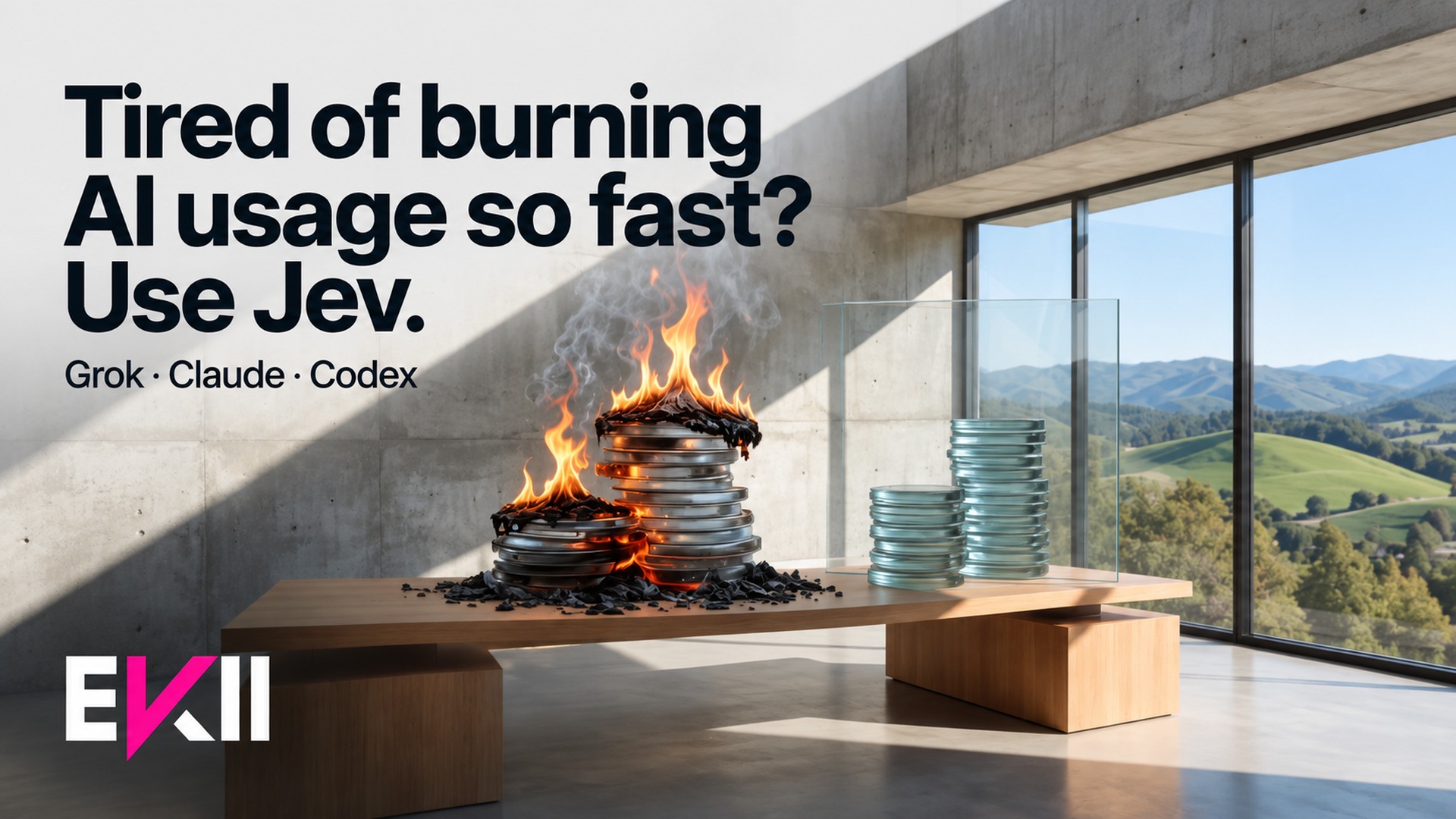
A typesafe gate that decides what not to run before Claude, GPT, Codex, or Grok eat your budget.
Most teams don’t have an “AI problem.”
They have a routing problem.
The same way you wouldn’t spin up a GPU cluster to check if a file exists… you shouldn’t wake a frontier model to answer:
- “Anything new?”
- “Is this urgent?”
- “Do we already have enough info?”
- “Is this even the right work-class?”
Those are decision questions. Not generation questions.
And that’s where Jev earns its keep.
I’m not going to over-explain Jev up top. Just know this: it’s the gate I put in front of expensive work so we stop paying frontier prices for boolean checks and status pings.
If you’re burning through Claude / GPT / Codex usage faster than you can create value, this is the simplest lever I’ve found.
The real leak: expensive models doing cheap thinking
Here’s the pattern I see (including in my own workflows before I fixed it):
- Someone asks a vague question
- You wake the biggest model you have access to
- The model spends tokens politely clarifying…
- Then you still have to route the work to the right place
- Meanwhile your weekly budget is now a smoldering crater
The fix isn’t “use smaller models.” The fix is: gate before expensive work.
Not with vibes. With a decision model that can return:
- a choice (route A/B/C)
- a score
- a boolean
- plus confidence
…and do it cheaply and consistently.
Jev (what it is, and what it’s not)
Jev is my “System One” decision layer—implemented as a TypeSafe System One decision model via Vercel AI Gateway (typesafe-ai/jev).
It’s good at deciding what should happen next.
It is not a writer.
Doctrine-level rule in my stack:
- Never Jev: drafts, tip mines, congruence prose, ChatGPT reviews, SMS/email, Imagine-style creative.
Jev doesn’t create the deliverable. Jev prevents you from creating the deliverable in the wrong place, at the wrong time, with the wrong spend.
The routing doctrine (the part that actually saves money)
This is the routing layer I use across EVKII and client work.
1) Wake routes (how much compute do we even wake?)
- quiet — do nothing (or log it). Most “FYI” belongs here.
- tip once — lightweight nudge when it’s worth human attention.
- wake_Grok — short command/process only (protect weekly).
- wake_Cloud — wake Cursor Cloud Claude / Codex grind when the work is real.
Key behavior: Gate BEFORE expensive work. If it’s not real work, it stays quiet.
2) Work-class router (what kind of work is it?)
- mine → Cloud (tip mines, scrapes, long extraction)
- congruence → Grok (short checks, process compliance, tight commands)
- draft → GPT/ChatGPT (articles, copy, structured writing)
- status → quiet (FYIs, acknowledgements)
- mutate_ask → HOLD human (if the ask changes requirements, don’t let a model guess)
That last one matters: mutate_ask → HOLD prevents the expensive “confident hallucination” loop.
3) Cloud model class (don’t burn frontier on FYI)
When we do wake Cloud, we pick a class:
- nano — cheap, fast, “good enough”
- balanced — default serious work
- frontier — only when the task truly needs it
Frontier is not a default. It’s a last mile.
4) Confidence policy (the anti-guess rule)
- If conf ≥ 0.85 → act
- Else escalate once (ask for the missing input or bump route)
- Never do long guesswork on expensive models
5) Budget pacing (protect the week)
- Target roughly ~14.2% of weekly Grok per calendar day
- If we’re over pace and urgency is low → quiet
- If urgency is mid → prefer wake_Cloud over wake_Grok
Where this saves Claude, GPT, and Codex
1) Claude (Cursor Cloud / Fable / long context work)
Claude is incredible at deep work, long context, and code grind. It’s also incredibly easy to wake it for nonsense.
Use Jev to route Claude only when there’s real “mine” or “grind.”
Concrete saves:
- Tip mines: scan notes and pull only actionable ops tips → mine → wake_Cloud (nano or balanced; frontier only if reasoning is genuinely hard)
- Scrapes / extraction: parse messy exports and normalize fields → mine → wake_Cloud
- Long code grind: refactor / implement tests / chase edge cases → mine → wake_Cloud (often balanced)
- Don’t wake Claude for status FYIs: “FYI pushed the branch.” → status → quiet (or tip once if truly important)
Net effect: Claude becomes a specialist you call for real work, not a concierge you pay to say “got it.”
2) GPT / ChatGPT (drafting and structured writing)
GPT is where drafting energy belongs: articles, copy, structured outputs. But GPT is also where people waste tokens on boolean checks.
Jev owns the boolean checks. GPT owns the draft.
Concrete saves:
- “Is there anything new in this thread?” → status → quiet or tip once — do not wake GPT to summarize nothing
- “Do we have enough info to write the post?” → Jev returns boolean + confidence; if conf ≥ 0.85 proceed to draft → GPT; if not, escalate once — don’t draft anyway
- “Write the LinkedIn article / landing page / email sequence.” → work_class=draft → GPT/ChatGPT — Jev never generates the prose
3) Codex (build / debug / grind)
Codex shines when there’s an actual build/debug loop. So the question becomes: do we need to grind at all?
Concrete saves:
- Vague bug report without repro → mutate_ask → HOLD human instead of waking Codex to guess
- Clear “implement feature X” → wake_Cloud (Codex grind)
- Unstable requirements → HOLD (clarify first)
- “Refactor now or later?” → Jev choice/score from urgency + risk; low urgency + over budget pace → quiet
Codex is expensive when it’s spinning without constraints. Jev prevents the spin.
4) Grok Bot (short command / process only)
Grok is best as a crisp operator: short command, process compliance, quick congruence checks.
Concrete saves:
- Process / congruence checks → wake_Grok (short, bounded)
- Tip mines / scrapes / long extraction → mine → wake_Cloud (don’t burn Grok weekly)
- Over ~14.2% daily pace + low urgency → quiet; mid urgency → wake_Cloud instead of chewing Grok
The FYI filter: stop paying for acknowledgements
If a message is effectively “Noted,” “Done,” “Received,” “No changes” — Jev routes it to quiet.
No summarization. No polite rewrite. No model wake-up.
That sounds small until you count how many FYI pings exist in a real operating day.
Building this at EVKII
At EVKII (Founder | CAIO), I’m wiring this routing discipline into how we operate—internally and with clients—so expensive models do high-leverage work.
Soft client context (services, not fake metrics): BrandonKress / i1031, The Answer Is, and Blessed Rides — decide first, generate second.
The point isn’t the tools. It’s the habit: decide first, generate second.
What EVKII is running live to save
This is the live gate, not a slide:
- Master Control Jev gate skill sits in front of expensive work
- Weekday lean-wake pilots at 10am, 1pm, and 4pm PT
- FYI → quiet — acknowledgements do not wake a model
- Tip mines / grind → Cursor Cloud
- Drafts → GPT
- mutate_ask → HOLD a human
- ~14.2% Grok day pace so the weekly budget doesn’t crater mid-week
If you want to implement this quickly
If you’re already on Vercel AI Gateway, Jev is a clean fit because it’s typesafe and built for this decision shape (choice / score / boolean + confidence).
Start simple:
- Add Jev as the first hop
- Implement wake routes (quiet / tip / wake_Grok / wake_Cloud)
- Add the work-class router
- Enforce confidence ≥ 0.85 to act
- Add budget pacing (quiet when over pace + low urgency)
You’ll feel the savings because the waste is front-loaded in routing mistakes.
Need help making your company more efficient?
If your team is burning Claude, GPT, Codex, or Grok on the wrong work — and you want an operating system that decides first and generates second — EVKII can help.
We build practical AI agent fleets, routing discipline, and usage gates like this for growth companies.
Book a strategy call or contact EVKII if you want this wired into your stack.
Apply for the free 10-page website · Request a 15-minute teardown